Saturday, July 18, 2015

Terps Schedule Smart

Three years ago Maryland wound up in the NIT at 22-12.  Much like everything else, it happened for a number of reasons (like an 8-10 ACC record), but the team was widely considered off the bubble by Selection Sunday after a strong ACC performance in large part due to a weak RPI driven down by a horrendous non-conference Strength of Schedule - 299th in the nation.  That's often a death knell for a power conference bubble team and seed deflater to those in the field.

Ten guarantee games will crush a team's SOS, but Mark Turgeon and staff deserve a ton of credit for recognizing and addressing that over the past couple of years, putting together stronger schedules that ranked 113th and 82nd overall.  The strategy looks to have been a blend of more premier opponents, mid-majors and stronger low-majors replacing games against the dregs of Division I, and some good scheduling fortune, like Ohio State and Virginia replacing Northwestern in the ACC-B1G challenge. The 2015 non-conference schedule was released earlier this week, and this looks like the best one yet.

The three premier games are @ North Carolina, UConn (Jimmy V Classic), and Georgetown.  All three should be improved over last year with North Carolina a national contender and the other two possibly contending for top 20 rankings.  The Cancun Challenge field isn't sexy, but all three of Illinois State, TCU, and Rhode Island all ranked in the kenpom top 75.  All told, only a home game against Marshall (11-21) is against a team with a sub-.500 record last year:

Team W L
North Carolina 26 12
Georgetown 22 11
Uconn 20 15
Illinois State 22 13
TCU 18 15
UMES 18 15
Princeton 16 14
Marshall 11 21
St Francis (NY) 23 12
Mount St. Mary's 15 15
Cleveland State 19 15
Rider 21 12

231 170
Overall SOS
0.5760598504

That NC SOS would have been 16th in the country last year.  Five of the twelve games being played away from home, including Princeton at Royal Farms Arena in Baltimore, help as well.  The Terps look like a national power on the court next year, and their schedule looks to set them up to be seeded as such even if they lose a game or two more than expected.

Sunday, May 31, 2015

Maryland's Got Talent

Things are falling into place.  Melo Trimble and Jake Layman passed on the NBA Draft to come back.  Robert Carter Jr. continues to lurk as an infusion of talent on the interior as soon as he's eligible next fall.  Diamond Stone spurned his hometown Badgers to join the Terps.  Rasheed Sulaimon is in, too.  He brings some questions after his dismissal from Duke last year, but there's no question that he's talented.

Talent is a loaded word.  Sometimes it means how many stars a recruit was coming into college, which is often a good proxy, but there are many counterexamples.  Other times it applies to certain skills.  A top shooter or scorer will get the nod as talented, but great defenders like Tony Allen or great rebounders like Dennis Rodman get called role players.  Again, fair to some extent, but it doesn't tell the full story.

I only add that digression because I'm going to make a bold claim -- next year's roster may be the most talented in school history, either one through five or one through ten.  To make that claim we need to look at the past contenders for that title.  Many are obvious, but the metric I'm going to use is NBA games played.  That means that for this exercise Steve Blake is "more talented" than Juan Dixon, which certainly wasn't the case here in the early 2000s, but nothing is perfect.

In broad strokes, the amount of NBA players on a college roster and the impact that they had at the pro level is a good view of the talent a team has.  Villanova was correctly a #1 seed last year (early exit be damned) over Arizona, but there's not much doubt which roster close followers of college basketball would say was more talented.  Ryan Arcidiacano might have shared the Big East Player of the Year award, but his NBA career arc is likely more Gerry McNamara than Kyle Lowry, as far as Big East point guards go.

So let's look at the ten most talented rosters in Maryland history, as judged by career NBA games played.

10) 1990 (1,596 games) - Gary Williams' first team wasn't lacking for talent.  The three leading scorers were Walt Williams (7th pick in 1992), Jerrod Mustaf (17th pick in 1990), and longtime NBA journeyman Tony Massenburg.  Evers Burns, another rotation player, would get a cup of coffee in the NBA.  Despite that roster, the Terps finished just 6-8 in the ACC and played in the NIT, but that was a vast improvement over the previous year's team that went 1-13 in the ACC with a similar roster under Bob Wade.


T-8) 1979 and 1980 (1,841 games) - Only two players from this team made it to the NBA, but both had long careers.  Albert King (10th overall) and Buck Williams (3rd overall) both went high in the draft in 1981.  Williams has a strong case for best pro career by a Terp, averaging a career double-double, and snagging Rookie of the Year and several All-Defensive Team honors over his 17 year career with the Nets, Trailblazers and Knicks.


7) 1975 (2,027 games) - While Tom McMillen and Len Elmore had graduated, this was another strong team in the Golden Age of Lefty Driesell, posting a 24-5 record and making the Elite Eight behind a tremendous backcourt of John Lucas and Brad Davis.  Both men would have long careers as NBA point guards, and hold the distinction of being the first four year stars for the Terps after the rule against freshman ineligibility was lifted in advance of Lucas' first season.

6) 2002 (2,038 games and counting) - The most famous team in school history, winners of its only basketball National Championship, checks in at just 6th on the list, though with Steve Blake still playing, this group will rise in the rankings.  Juan Dixon and Lonny Baxter had modest NBA careers considering their stellar, four-year careers in College Park, but coming out of college, most realized that their physical gifts lagged behind their skills.  Chris Wilcox did have those gifts, but his skills didn't catch up enough for him to be more than a useful NBA player over his eleven years in the league.

5) 1976 (2,040 games) - Lucas and Davis returned from the 1975 team, and the five leaders in minutes played all spent time in the NBA, including Steve Sheppard, Lawrence Boston and Mo Howard.  The team itself was a disappointment, though.  The 22-6 record wasn't as good as the year before, and despite spending eight consecutive weeks at #2 in the AP Poll, spent the postseason at home.  While the tournament had expanded to 32 a year prior to include at-large selections, each conference was still limited to two selections.  After 6th seeded Virginia surprisingly won the ACC Tournament, #8 North Carolina was selected as the league's at-large instead of #11 Maryland.


4) 1981 (2,075 games) - Two things emerge from this list - talented Lefty Driesell teams that disappointed on the court.  This was the same King/Williams squad from earlier in the list, adding eventual NBA pick Charles Pittman inside, that grabbed a #2 seed in 1980.  Despite a preseason #4 ranking in the AP Poll, the Terps sputtered to a 21-10 season before being crushed by Indiana in the second round of the NCAA Tournament as a #6 seed.


3) 2001 (2,177 games) - Add Terence Morris to the 2002 National Championship game and you've got the roster for this one.  Morris had a disappointing pro career compared to predictions earlier in his college career, playing just parts of three seasons with the Rockets and Magic.  Morris averaged over 15 per game his sophomore and junior seasons and was 1st-Team All ACC his sophomore year.  He was also 6-9 with perimeter skills, a rarer combination 15 years ago.  Despite that, Morris stayed four years, and had a down season statistically his senior year as the team made it's first Final Four.  He would drop from a projected high first round pick to a second round guy and most of his best pro success came in Europe.

2) 1974 (2,347 games) - Tom McMillen, Len Elmore, John Lucas,  The Greatest Game Ever Played (fittingly, a Terps loss).  Finishing the year ranked in the top 5 in the country but at home for the postseason because only one team per conference could make the NCAA Tournament and the team declined an NIT bid, having won that tournament two years ago with the same group.  Maryland fans are among the best at paying the What If? game, and while alternate worlds where Len Bias lives and Moses Malone makes it to campus are prominently featured, perhaps none is talked about more than the idea of at-large bids in the early 1970s.  The 1972 and 1974 team went a combined 46-10 those two years, playing in the ACC, but never got the chance to play for a National Championship.

1) 1973 (2,403 games): This was the 1974 team plus Jim O'Brien, a Small Forward who played 58 games in the ABA.  O'Brien was actually the second leading scorer for the team, ahead of Lucas and Elmore.  This team was 20 minutes from a Final Four before eventually falling to Providence.  Close but no cigar.

Monday, May 18, 2015

To the Draft

The Coaching Carousel is still spinning with Billy Donovan moving from his longtime home at Florida to new challenges with the Oklahoma City Thunder, and the transfer recruiting market continues on, but one facet of college basketball's hot stove league wrapped up at the end of last month as the deadline to declare for the NBA Draft passed.

The off season seemed to start with almost every key underclassmen declaring that they'd be going pro.  Duke's three and Kentucky's seven led the way early, and upper lottery picks D'Angelo Russell and Stanley Johnson confirmed the obvious late in the cycle.  The annual WTF entries were present, too.  Former Maryland reserve Ashton Pankey got a degree and had a fine season for MAAC Champ Manhattan this year, his fifth in college, and decided to leave a year of eligibility on the table to pursue an NBA career.  Pankey has no chance of being drafted, of course, but with former teammates Jordan Williams and Terrell Stoglin declaring early in the past few years, Gary Williams' last team somehow has the distinction of having three early entries on the roster.  Truth is indeed stranger than fiction.

Anyway, 48 guys put their name on the list, the third highest total of the nine years we've had the One and Done rule.

2007
2008
2009
2010
45
48
2013
2014
2015
32
38
39
50
44
49
46
45
48


Things look a little "worse" (for a college basketball fan) when you concentrate on only the major conference players.  The mid-majors (and below) have some first round talent among this year's crop of early entrants like Cameron Payne of Murray State and Georgia State's RJ Hunter, who created this year's March Madness Moment, but the lion's share of NBA Draft talent is obviously in the Power 6. 36 power conference players declared early, tied for the most in the last nine years.

2007
2008
2009
2010
2011
2012
2013
2014
2015
23
26
26
32
33
36
30
36
36

Who was hurt most?  The SEC had a staggering 13 players declare early.  We all know about Kentucky's 7 players, but Arkansas, LSU  and even lowly Florida had a pair as well.  Fringe prospects like Tyler Ulis and Dorian Finney-Smith are the best of the bunch returning to school next season.

ACC
Pac-12
SEC
Big Ten
Big XII
Big East
11
5
13
4
3
0

The Big East didn't have a single player leave early.  It was a senior laden conference last year, with only D'vauntes Smith-Rivera of Georgetown and Providence's Kris Dunn seriously considering throwing their names into the ring.  There's a lot of talk about what the future holds for the newly configured Big East and so it will be interesting to see whether the lack of high end talent continues.  The conference landed only two of the top 45 players in the 2015 recruiting class.

One trend emerges when you look at the entire nine years of data concerns the Big Ten.  The conference has been struck by far fewer early entries than peer conferences at just 3 a year, while other power conferences average 5.5 a year.  It might not sound like a huge difference, but imagine how different the perception of the B1G would be heading into next season if Melo Trimble and Caris LeVert decided to enter their names into the draft.  Two players won't kill a league, but it can go a long way to dropping it in from first to third in the mythical league power rankings the following winter.

Tuesday, April 21, 2015

Grad Transfers

Transfers are ruining college basketball.

Alright, now that we've got the Coaches' Viewpoint out of the the way, let's talk about transfers. Player movement in college basketball is seemingly at an all-time high.  That's been a theme for several seasons now, and it might best be exemplified by the relatively new, but still rapidly expanding, graduate transfer loophole, which allows any player with an undergraduate degree and eligibility left to transfer to a new school, free from the restraints of the "year in residence" the NCAA requires traditional transfers to sit out from competition.

The appeal is easy to see.  Big-time programs can poach from lesser ones with somewhat proven commodities who can come in immediately and address needs, almost certainly faster than the lightly recruited high school players still floating around in the spring after the season ends.  But one question remains - just how effective are these players when they move to their new schools.

Using Luke Winn's outstanding research as a starting point and filling some gaps with Jeff Goodman's exhaustive transfer list, I put together a list of players who used the graduate transfer exemption to transfer "up" over the last four seasons, where transferring up is defined (by Winn) as going from a mid or low-major to a power conference school, or transferring from a major program to a blue blood.

The graduate transfer exception has been used by major programs at every level.  While Duke hasn't dipped their toes into the water just yet, North Carolina, Kentucky, and Kansas all have, and UCLA attempted to bring in Jon Octeus from Colorado State before he was denied admission and wound up at Purdue.  2012 National Champ Louisville will bring in its first graduate transfer in Cleveland State's Trey Lewis.

Oregon and Boston College have brought in the most grad transfers at four apiece, followed by Illinois, Purdue, Tennessee and Fred Hoiberg's transfer factory, Iowa State at three each.  Auburn, Indiana, Maryland, UConn, USC and Wake Forest have all brought in multiple grad transfers.  UConn just locked up its third in former Cornell Forward Shonn Miller, and Maryland is trailing Damion Lee, the star of this year's transfer menu.

By and large, these players are performing well when they move up a level.  Taking out of the equation a few players like Jon Horford (Michigan to Florida) and Justin Knox (Alabama to North Carolina) who already had power conference experience, I looked at the year-to-year changes after players moved to the big-time, focusing on three categories: ORtg (to judge efficiency), Poss% (to judge how involved they were) and Mins% (to see if they were more than benchwarmers).

Grad Transfers

So that's promising.  ORtg actually increases at the higher level in season 2, although that's offset by a drop in usage and playing time.  You probably need to be a little careful in projecting this out going forward since we don't know what the increased pool of graduate transfers will do to the quality of that pool.  If schools are currently drawing a random sample from, say, the top 5% of mid-major and low-major players, will they draw more players from that same pool or reach down further in the hopes of landing a one year band-aid.  Tough to say, but I'd guess the latter happens a bit more frequently as the grad transfer continues to proliferate.

And here's the list for reference.

Grad Transfer List

Monday, March 23, 2015

On Luck

Maryland does it again.  For the school record 26th time this regular season they won a game, and for the tenth time in ten tries, the team won a game decided by one or two possessions.  That leads to an interesting situation for a 26-5 Big Ten team ranked #8 in both polls and top 10 in the RPI -- the computers hate them.  Ken Pomeroy's laptop continues to blatantly disrespect the team's skills, ranking them a paltry 32nd in the land, while Jeff Sagarin's iMac has the team at #25 and Basketball on Paper author (basketball is played on a court, guys) Dean Oliver's ESPN BPI splits the difference at #28.

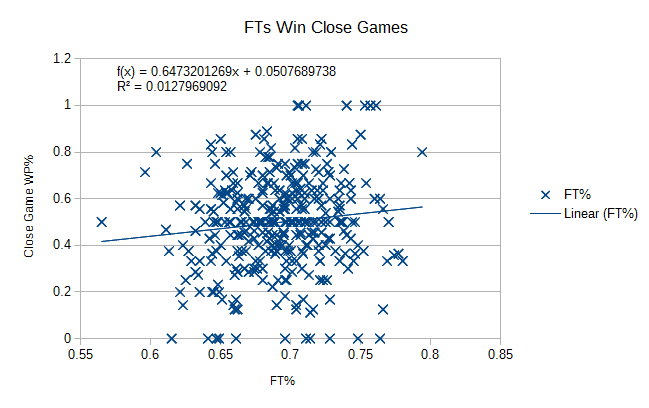
Obviously I love the metrics, but there's a natural uproar from Maryland fans who feel disrespected by the computer rankings, offering a number of reasons why the Terps are so good in close games.  Some of them boil down to little more than the typical "grit arguments", but some are a bit more intriguing.  The one that gets mentioned most frequently is probably the Free Throw Postulate.  It states, roughly, that Maryland isn't lucky because they have a such a big spread between their FT% (one of the best in the country) and their opponents' (one of the the worst).  For the most part, the close wins this year were Maryland staving off a furious comeback by taking care of the ball and getting theirs at the foul line. To that end I looked at some data from teamrankings.com, comparing FT% and winning% in close games, where "close" is defined as final margin of < 5.  Then I graphed it.  Here's what that graph looked like for the 351 DI teams this year:

[caption id="attachment_335" align="alignnone" width="625"]source: teamrankings.com source: teamrankings.com[/caption]

So there's a slight positive relationship, not a strong correlation, but the trend line says that the worst foul shooting team wins 40% of its close games and the best foul shooting team wins 60%.  That's one game above the 5-5 median for a team on the far right hand portion of the graph.

The common misconception is that the Terrapins are ranked low in the computers because they're being penalized for the luck of winning close games.  That's not really true.  When Maryland beat Michigan State 68-66 earlier this year in East Lansing, it was probably lucky to escape from the Breslin Center with a win, but the computers didn't really care.  Their algorithms would say that regardless of whether you flipped that score, Maryland had played a good game and would be "rewarded" by the computers.

Conversely, it doesn't really matter that the Terps were on the right side of close games against Penn State or Northwestern.  It's obviously better to have won those games for any number of reasons, but the computers downgraded Maryland because they played so many close games against inferior competition, even going back to the beginning of the season when they struggled with USC-Upstate and couldn't put away Monmouth.  Top 10 or 15 teams might occasionally play down to their competition, but struggling every time out against the dregs of the conference means is a good sign a team's record is inflated.

Bottom line: The Terps are good, but there's good reason not to believe the record at face value.

Saturday, March 7, 2015

Wednesday, February 25, 2015

Conference Title Hunting

Yesterday every Terps fan (or maybe just some of us) was doing mental gymnastics to parse all the scenarios that would get Maryland a top four seed and double bye in the Big Ten tournament in two weeks.  That was the big one, and it's not easy with a half dozen teams still fighting for three spots.  We were also hoping that Maryland would at least be competitive against #5 Wisconsin at the Xfinity Center.  It's not that a loss was a sure thing, but rather given the teams uneven performance in the last month, we might have settled for sweeping Michigan, Rutgers and Nebraska to finish the season.

But since the Terps decided to go ahead and set off a flash mob, pack the lower bowl with gold, storm the court, and oh yeah, win last night's game, a beautifully played 59-53 win over the heavily favored Badgers, we can at least peak at their prospects for nabbing a share of the conference regular season championship.  However faint those hopes are, they increased markedly last night, and given that we've shared just one regular season title since 2002, it's worth investigating.

As usual, we'll use kenpom's projections for each team's final three games.  The caveat is that you can make a very compelling argument that Pomeroy is too bearish on the Terps.  Despite a 23-5 record and a half dozen or more wins over likely NCAA Tournament teams, Maryland ranks just 35th in those rankings behind Ole Miss and Xavier and seemingly a cast of thousands.  His rankings are clearly an outlier among major computer rankings, but hey, no sense splitting hairs too much.

Anyway,KP give Maryland an overwhelming chance of beating Michigan (81%) and winning at Rutgers (80%), and puts them as a solid favorite in Lincoln (64%).  Here's the breakdown:

Terps Final Three Probability
Maryland's Last Three games


Not bad.  Two wins clinches the bye, and speaking purely by the numbers, it would be a shocker if the Terps didn't get there.

Wisconsin's schedule was heavily backloaded, and their final three are much tougher.  They get Michigan State next for Senior Night, their only game against the Spartans, and then next week has two road trips, one to feisty rival Minnesota and the other to Ohio State, the only game between the preseason presumptive top two in the Big Ten.  Wisconsin still looks like a healthy favorite in the first two (82% and 75%), but the Ohio State game is much closer to a coin flip (54%).

Wisconsin's last 3 games
Wisconsin's Last Three Games


Two wins clinches an outright B1G title for Wiscy, so you can probably already tell that Maryland isn't at even odds.  There are three scenarios that work for Maryland.  If the Terps sweep, Wisconsin can win either one more or none (for an unlikely outright B1G title) or if the Terps drop one than Wisconsin has to lose all three.  The realistic scenario is Maryland at 3-0 and Wisconsin at 1-2.

So yeah, put it all together and Maryland has a 9.25% chance to do it.  Let's say it's 1 in 10 and call it day.  Those certainly not great odds, but they also aren't zero, which is amazing to say on February 25.  It's safe to say that the preseason prediction of 10th in the Big Ten was a little off base.